



— By Bryan Icenhower —
How reliable access to live sports fosters habitual loyalty.
In today’s dining landscape, reliability may be the most underrated driver of customer loyalty.
For sports fans, choosing where to watch isn’t casual, it’s intentional. Whether it’s an NFL Sunday, a cross-state college football rivalry, an MLS playoff or a Formula 1 Grand Prix, fans pick restaurants and bars where they can reliably watch the game.
For restaurants, customer loyalty isn’t limited to a one-time visit. It’s about encouraging customers to return time and again. When guests know they can count on a venue to have their favorite team on every time, that reliability turns gameday traffic into long term customer relationships. In a competitive environment with tight margins and a critical need for customer loyalty, dependable sports access becomes operational infrastructure rather than just entertainment.
The Reality of the Streaming Environment
Delivering that consistency has become increasingly complicated.

Just a decade ago, most live sports were accessible through a traditional cable bundle. Today, that simplicity has given way to a far more fragmented distribution landscape, with premium live sports increasingly shifting to streaming platforms. Amazon Prime Video now carries the NFL, NBA, The Masters and NASCAR. Netflix has added the NFL, MLB, WWE and combat sports. Peacock is home to the NFL, Premier League, Big Ten and the PGA Tour. UFC and the UEFA Champions League are on Paramount+, while F1 and MLS have established footholds on Apple.
What was once largely centralized within the traditional pay-TV ecosystem is now spread across an expanding array of streaming platforms.
Even in a hypothetical world where consumer streaming apps were authorized for commercial use (which they are not), stitching together premium live sports across multiple standalone services would be an operational nightmare for most commercial venues. These apps and devices were built for the living room, not for commercial environments where operators need devices with low latency, synchronized screens, centralized control and reliable performance across the venue.
Unlike residential viewers, bars and restaurants cannot tolerate buffering, failed logins or lost signals at game time. In a commercial setting, even a brief disruption during a key moment is more than frustrating. It can immediately undermine the guest experience, depress food and beverage sales, reduce staff tips and turn what should have been a repeat visit into a one-time disappointment.
From a facilities and operations perspective, the shift to streaming has heightened the importance of getting the underlying environment right. Reliable connectivity, sufficient bandwidth, properly configured displays and centralized control are no longer just technical considerations. They are now essential to delivering a smooth, revenue-generating gameday experience.
NFL Sundays: A Loyalty Engine
The NFL season offers one of the clearest examples of how reliability drives repeat behavior. Guests often arrive with a specific expectation, whether that is watching their favorite team, taking in the full afternoon slate or tracking their fantasy players across multiple games. When a venue consistently delivers every game across multiple screens without interruption, it earns trust. Over time, that trust becomes a habit. The first visit may be driven by a single matchup, but loyalty is built through consistent execution.
That execution starts with the right content package. But rights alone are not enough. It also requires the ability to deliver that content reliably across the venue, with the right screen setup, clear audio control and a platform that makes gameday management intuitive for staff. In the streaming era, the best systems do not add complexity for operators. They reduce it and help make the guest experience seamless.
Live Sports as a Point of Emphasis
For years, live sports could be treated almost like a utility: buy the package, turn it on and trust that the games would be there. That is no longer enough. As sports rights continue to fragment across broadcast and streaming platforms, the challenge for operators is no longer just accessing content; it’s managing how that content is programmed, delivered and experienced across screens, staff and service windows.

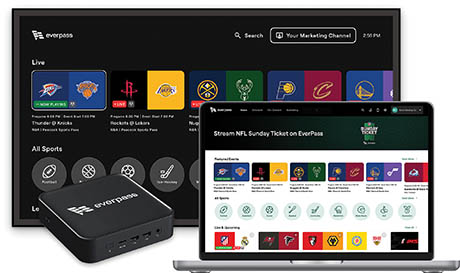
That’s where platforms that are more than just a content offering play a critical role. Such platforms serve as the control layer for sports programming, enabling operators to pre-schedule live events, manage screens across one or more locations and centralize control through a single interface.
This level of control reduces the operational burden on staff, eliminating the need to juggle remotes, switch inputs mid-shift or troubleshoot logins during live play. Instead, teams can focus on delivering a consistent guest experience, knowing the right game will be on the right screen at the right time.
For operators, reducing fragmentation isn’t just about convenience; it’s about creating consistency at scale while maintaining full control of the viewing experience.
Community Building & Customer Experience
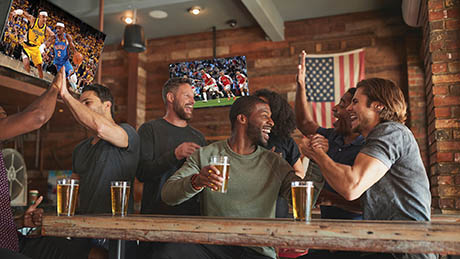
The value of live sports extends beyond direct revenue. Sports are inherently communal and are almost always better when experienced together. That is why alumni groups, fan clubs and neighborhood regulars gravitate toward the same trusted venues for watch parties and big moments. Restaurants that consistently deliver great sports coverage do more than serve food and drinks. Over time, they become gathering places, neighborhood institutions and the home base for local fan communities.
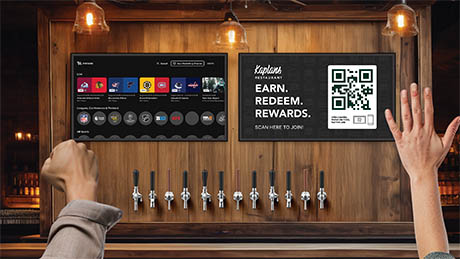
When sports programming is consistent, revenue becomes more predictable. This predictability enables better staffing models, preventive maintenance scheduling and inventory planning.
By reducing technological complexity and centralizing access wherever possible, restaurants can protect the guest experience while easing operational strain.
In the bar and restaurant environment of 2026, with limited labor and maintenance teams juggling multiple responsibilities, streamlining sports delivery allows staff to focus more on hospitality rather than troubleshooting.
Consistency as an Asset
In an era of endless dining choices, small but consistent advantages often separate one venue from another. For sports-driven traffic, the most important may be the simplest: reliably showing the game. When guests know they can walk in and trust that their team will be on, that confidence builds trust. Over time, that trust becomes habit, and habit becomes loyalty.
Live sports has evolved beyond a one-time draw. It is now a repeatable driver of traffic, where consistency often matters more than any single matchup. Restaurants that deliver that experience every time can turn single-game visits into long term customer relationships. In today’s dining landscape, that reliability is a true competitive advantage.
— Bryan Icenhower is chief marketing officer at EverPass Media, a media and technology platform that aggregates, distributes and enables streaming of live sports and entertainment content, along with consumer engagement and performance marketing tools for bars, restaurants, hotels, etc. EverPass was founded in 2023 in partnership with RedBird Capital Partners and 32 Equity, an investment arm of the NFL. TKO Group Holdings, parent company of UFC and WWE, joined as an investor in 2024. For more information, visit https://everpass.com/.