

— By Matt Browning —
How QSR chains are moving beyond reactive maintenance.
For a quick-service restaurant operator managing hundreds of locations, equipment failure is never just a maintenance problem — it’s a guest experience problem, a food safety problem and a bottom-line problem…all at once. A malfunctioning HVAC unit on a hot summer afternoon sends customers out the door. A refrigeration anomaly discovered too late means spoiled inventory and potential health code violations. An emergency repair call on a holiday weekend carries a price tag that can erase a week’s worth of margin.
For years, the default response to these challenges was reactive: wait for something to break, then fix it. But a growing number of QSR chains are moving toward what is increasingly being called the Energy Intelligence Model — a data-driven approach that uses real-time energy and equipment monitoring to surface problems before they become crises. The shift is redefining what modern facilities management looks like at scale, and the results are measurable.
The Cost of Waiting
Reactive maintenance is expensive in ways that extend well beyond the repair invoice. Emergency service calls command premium labor rates. Unplanned equipment downtime disrupts operations during peak hours. Repeated stress on aging systems shortens asset lifecycles and accelerates capital replacement cycles. And for multi-unit operators, these costs compound quickly across a large portfolio.

In a multi-site QSR environment, facilities teams are almost always operating with lean staffing relative to the scale of what they’re managing. By the time a store manager notices something is off and escalates it, the situation has often already crossed the line from a routine service issue into an emergency — and that’s where costs really start to climb.
The challenge has historically been one of visibility. Facilities teams at large QSR chains are managing geographically dispersed locations, often relying on manual check-ins, reactive work orders and inconsistent reporting from the field. Without a centralized, real-time view of how equipment is performing across sites, staying ahead of failures is more aspiration than practice.
Data as a Diagnostic Tool
The emergence of connected energy management technology has begun to change that equation. By installing sensors and controls across HVAC, lighting and refrigeration systems, operators can now monitor equipment performance continuously — tracking runtime patterns, temperature variances, energy consumption and anomalies that signal a system under stress.
The practical impact is significant. Rather than waiting for a piece of equipment to fail, facilities teams receive alerts when performance deviates from established baselines. An HVAC unit running longer than usual to maintain setpoint temperatures may indicate a refrigerant issue or a dirty coil — problems that, caught early, require a routine service visit rather than an emergency replacement. A refrigeration case showing unusual temperature fluctuations can trigger an inspection before product loss occurs. In both cases, the intervention is planned, not panicked.
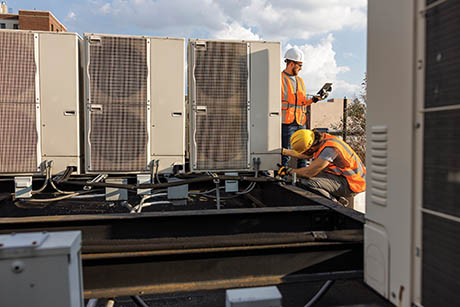
The Energy Intelligence Model’s shift from reactive to proactive maintenance has tangible financial implications. Fewer emergency service calls mean lower labor costs and reduced truck rolls. Planned maintenance visits are more efficient — technicians arrive knowing what they’re looking at, with the right parts and tools. And equipment that is serviced proactively simply lasts longer, deferring capital expenditure and improving the return on existing assets.
One of the most consistent outcomes when operators make this transition is that their HVAC service relationships improve alongside the financial results. When technicians have access to real-time performance data ahead of a visit, they arrive prepared — calls are shorter, repairs are more targeted and equipment outcomes are better across the board.
A Case Study in Scale
Few QSR contexts illustrate the potential of this approach more clearly than a large national chain managing thousands of locations. At that scale, even incremental improvements in equipment up-time and energy efficiency generate returns that are difficult to achieve any other way. One major QSR brand that deployed a connected energy management platform across its portfolio — integrating controls and monitoring across HVAC, lighting and refrigeration — has seen exactly that kind of compounding impact.
The operational outcomes have been substantial. The brand achieved an average 13.8% reduction in energy consumption across participating locations, with energy use per restaurant down 20% compared to a prior baseline — a benchmark tied to the brand’s participation in the U.S. Department of Energy’s Better Buildings Challenge. Those efficiency gains translated to $3.5 million in annual energy cost savings, a figure that reflects not just smarter energy use, but reduced maintenance costs, fewer emergency repairs and extended asset lifecycles across the portfolio.

The platform also gives operators the ability to remotely monitor and adjust temperature setpoints and schedules across locations — ensuring consistent guest comfort and kitchen conditions without requiring on-site intervention. During off-hours, low-traffic periods or holidays, energy use is automatically scaled back, capturing savings that would otherwise go unrealized.
From a risk management standpoint, continuous refrigeration monitoring has strengthened the brand’s ability to protect food quality and maintain compliance with health and safety standards. Early detection of anomalies means the chain can respond to potential issues before they result in product loss or regulatory exposure — a meaningful operational safeguard at that scale.
The Sustainability Dividend
For QSR operators, the business case for energy intelligence increasingly extends beyond cost savings alone. Sustainability commitments — once treated as a separate corporate initiative — are becoming integrated into how facilities teams measure and report performance. The same platform driving operational efficiency at the brand referenced above is also underpinning its verified ESG reporting, helping the company track and communicate progress toward its emissions reduction goals.
The results on that front are notable: a 47% reduction in Scope 1 and 2 emissions, a 55% reduction in franchise emissions per restaurant and more than 30,000 metric tons of CO2 avoided annually. These are outcomes verified through the same data infrastructure that drives day-to-day facilities decisions — and that alignment between operational performance and sustainability reporting is increasingly what investors, franchisees and regulators are looking for.
What This Means for Facilities Teams
The broader lesson from this kind of deployment is one that applies across the QSR industry: the tools to move beyond reactive maintenance exist, they are proven at scale and the financial case for deploying them is compelling. For facilities and operations managers evaluating where to focus in the year ahead, energy intelligence represents one of the clearest opportunities to reduce costs, improve operational reliability and build a more resilient portfolio.
The operators who get the most out of this technology are the ones who treat the data as a management tool, not just a reporting tool. When a facilities team is reviewing real-time performance across every location on a daily basis, it changes how they prioritize work, how they communicate with service providers and ultimately how they run the portfolio. The savings are real, but the bigger shift is cultural — moving from a posture of response to one of control.
In an industry where margins are thin and the pressure to perform is relentless, that kind of operational confidence is worth a great deal.
— Matt Browning is the director of energy advisory services at GridPoint, where he leverages nearly two decades of industry experience to drive innovative solutions in the energy sector. Since 2003, GridPoint has been a leader in energy optimization technology that decarbonizes commercial buildings and accelerates a more sustainable energy future. Visit www.gridpoint.com.