
— By Katie Lee —
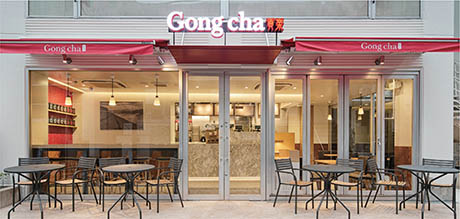
2026 marks the full rollout of Gong cha 2.0, a comprehensive modernization of technology, operations and store design for the bubble tea leader.
Gong cha is the world’s leading bubble tea brand with nearly 2,200 locations in 33 markets globally, including more than 240 stores in the U.S. across 23 states, Washington, D.C. and Puerto Rico. But it still has plenty of room to grow — both in number of locations and in brand recognition — in the United States.
With a solid foundation undergirding its success globally, Gong cha now intends to build upward and outward in the Americas — laying the groundwork for future franchise success.

“The brand has built an incredible international foundation, and the Americas region is now one of our most exciting growth frontiers,” says Geoff Henry, Gong cha President of Americas. “As we’ve seen, bubble tea’s growth in the U.S. is sustained. What was once a niche category is now becoming a mainstream beverage choice, especially among younger consumers who value customization, global flavors and experiential brands.”
Last year was a huge year for development — focused on strengthening the Gong cha pipeline, signing new franchise agreements and expanding into key Western markets like Arizona and the Pacific Northwest. Now, it’s time to execute those plans.
“We’re entering a true acceleration phase, and 2026 will be a pivotal year for new store openings and brand visibility, with over 75 expected openings,” Henry says.
Gong cha was founded in Taiwan in 2006 with a simple mission: serve the highest-quality tea with an uncompromising focus on consistency, customization and hospitality. Over the past two decades, that commitment has allowed the brand to grow into one of the most recognizable premium bubble tea concepts in the world. Now it is entering its next chapter of global evolution.
“Our long term goal is to surpass 500 stores in the Americas in 2026, and over 1,000 by 2029; every initiative we’re launching today, from technology to store design, is built to support that scale,” Henry says.
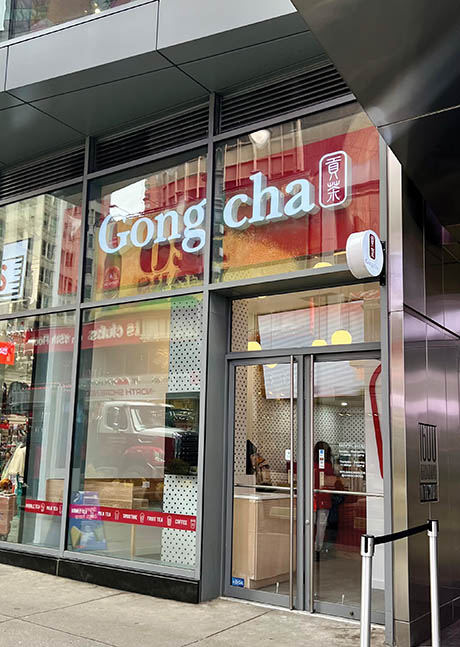
To support its ambitious scale, Gong cha recently unveiled its global Gong cha 2.0 initiative: a comprehensive digital, operational and design refresh to optimize profitability, efficiency and scalability for franchisees — as well as improve the guest experience.
“Gong cha 2.0 is the convergence of three pillars: beverage automation, digital ordering and a new store model designed for speed and scalability,” Henry explains. “It’s the most comprehensive transformation the brand has undertaken since entering the U.S.”
The global rollout combines two key technologies — Super Wu beverage automation and self-order kiosks — with a modernized store design to streamline operations, reduce labor demands and improve throughput without compromising quality or hospitality.
“Super Wu and our self-order kiosks are the backbone of the transformation, but the real story is how these tools work together to create a fully connected ecosystem, from order to pickup to data analytics.”
Super Wu Delivers Automation & Consistency
Named after Gong cha founder Wu Zhenhua, Henry explains that Super Wu “automates the most repetitive parts of beverage preparation, dispensing tea, syrups, sweeteners and creamers with exact precision. That dramatically improves throughput, order accuracy and gives franchisees real-time production data that helps them manage inventory and labor more effectively.”
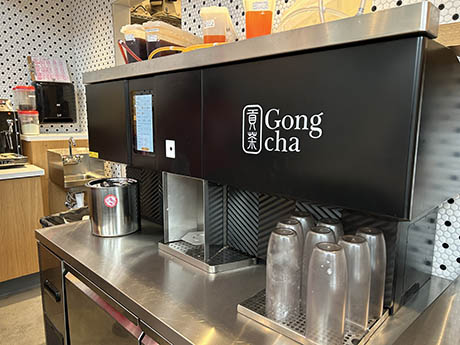
Super Wu has been in development and pilot testing for over 2 years, with trials conducted in more than 40 stores across 13 countries. “That global pilot gave us the confidence to begin rolling out the system at scale,” Henry says.
In 2026, Super Wu is being rolled out globally. Two U.S. stores are already operating with Super Wu, and all new stores globally will open with the system installed. That includes upcoming locations across the Americas, Asia, Europe and the Caribbean.
“Because we’re a global franchise system, the rollout will happen in phases,” Henry says. “Our long term vision is for Super Wu to become the global standard across our 2,200+ locations.”
To date, Super Wu has been shown to increase productivity by up to 65% during peak hours; reduce average drink prep time by nearly a full minute; and enable faster service, shorter queues, consistent drink quality and accurate order customization across more than 200,000 possible drink combinations.
Franchisee feedback has been extremely positive. In addition to productivity gains and nearly a minute shaved off drink prep time, franchisees cite easier onboarding and training for new team members, as well as significantly reduced stress during rush periods.
Most importantly, the system enables stores to open with one team member and operate efficiently with just two, which is a major advantage in today’s labor environment.
Beyond speed, the system delivers back-end operational intelligence that allows operators to track production data in real-time — enhancing inventory management, forecasting and cost control, and ultimately contributing to stronger margins for franchisees.
Digital Ordering & Data Capture
Every new Gong cha 2.0 store comes equipped with two self-order kiosks, now a core component of the brand’s digital-forward guest experience.
“Kiosks and digital ordering allow guests to explore customization easily and help us capture first-party data that fuels loyalty, targeted promotions and menu innovation,” Henry says. “When you connect these systems end-to-end, you create a model that’s faster, more profitable, easier to operate and more scalable.”
More than 80% of guests opt into the loyalty program (via phone number capture) at the kiosks during checkout, giving the brand a valuable owned-marketing channel for reengagement and targeted offers.
“That opt-in rate is incredibly powerful,” Henry says. “It gives us a direct relationship with guests and allows us to communicate through offers, limited-time promotions and new product launches.”
Gong cha can trace its uptick in digital ordering straight back to the pandemic years. “Guest behavior changed dramatically during the pandemic, with a major shift into digital ordering, and those demands never went away,” Henry says. “Convenience, speed and digital control are now baseline expectations. However, digital ordering isn’t just a convenience feature; it’s now central to the industry’s growth and guest interaction.”
Today, Henry says, about 70% of the company’s U.S. transactions happen through kiosks. The company also sees a 10% to 15% higher average ticket values from kiosk orders.
These tech-driven innovations enable operators to maintain faster, more consistent service, while freeing up time to focus on hospitality and the guest experience. Gong cha’s team members continue to supply artisanal touches, including brewing tea from premium quality tea leaves throughout the day; adding toppings, milk foam, ice and freshly cooked boba; and shaking each drink to-order. Rooted in the brand’s Asian heritage, Gong cha 2.0’s new “drink hand-off” initiative trains team members to present each beverage with both hands, and to personally address guests by name.
“Technology makes us faster, but hospitality is what makes us memorable,” Henry says. “Our drink handoff initiative trains team members to present each beverage and address guests by name. That tradition comes from Asian hospitality culture and reinforces our commitment of using technology to enhance the guest experience with personalized world-class hospitality.”
Super Wu and kiosks give the team members the opportunity to focus on true connection, which is at the heart of the Gong cha experience.
Modern, Functional Design
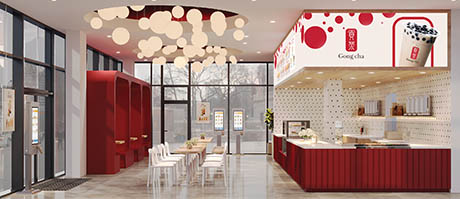
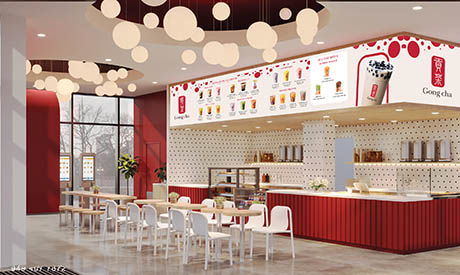
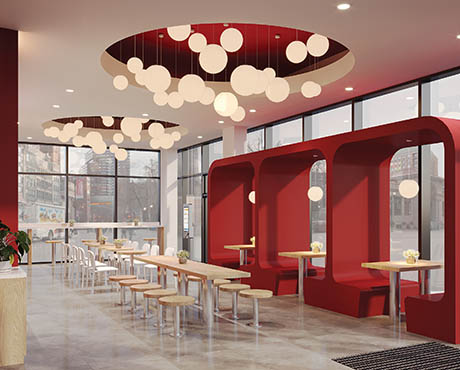
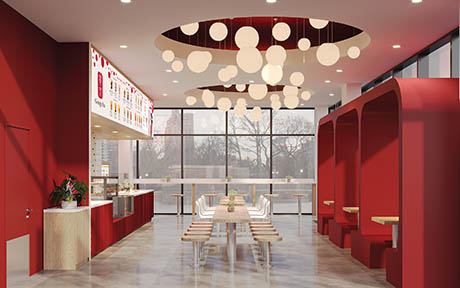
Gong cha 2.0 also introduces an updated store design to modernize the guest experience and enhance operational efficiency. First piloted overseas in 2024, the new layout is currently being rolled out across new U.S. stores. The new look reduces buildout/remodel costs and drives greater profitability for franchisees. The ultimate goal is to ensure a visually memorable environment that supports brand storytelling, while enabling faster, smoother service.
Key 2.0 design features include:
• Bright, open store layouts that put the full drink-making process on display.
• Large digital menu screens that replace static boards for real-time content and promotions.
• Single-pod seating creates an inviting environment for social moment.
• Branded visual storytelling through illuminated SEG lightbox tea field frames and a 3D global tea timeline that celebrate Gong cha’s culture and craft.
• Warm materials, bold red and white color schemes, and signature “pearl” chandeliers anchor the brand’s new visual identity.
• A new grab-and-go section offering bottled drinks and expanded food options to boost check average.
“The new prototype was designed with franchise profitability and flexibility as the top priorities,” Henry says. “We’ve learned a tremendous amount from operating locations globally. Gong cha 2.0 applies those learnings to reduce buildout costs, optimize space and improve workflow.”
The new look is modern but also preserves the spirit of hospitality rooted in Gong cha’s Asian heritage.
“This was incredibly important to us,” Henry says. “We wanted to modernize the brand while staying deeply rooted in the culture and craftsmanship that make Gong cha unique. It’s modern and visually striking, but it still tells the story of our origins and our commitment to tea craftsmanship.”
The new prototype can operate on a smaller footprint and requires fewer people to run it — thanks to automation and digital ordering. The optimized layout improves speed of service and throughput, while costs for buildouts and remodels are reduced. The result is a store that’s streamlined to open, efficiently staffed and more structured to run.
“That balance between technology and craft is resonating strongly,” Henry says. “Franchisees are invigorated by operational benefits, faster throughput, simplified training and new design. Guests continue to value the speed and the modern experience and appreciate that the handcrafted feel hasn’t gone away. They still see tea brewed fresh, toppings added by hand and drinks shaken to order.”
Scalable for Franchise Growth
With Gong cha 2.0, franchisees gain a future-forward store model built for higher volume, lower staffing needs and long term profitability, while still honoring the brand’s heritage of quality. The rollout is currently underway in the U.S. and select international markets, including upcoming stores in California, the Bahamas, Japan and Korea.
“The next 5 years are about scaling smarter, leveraging Gong cha 2.0, expanding into new territories and continuing to build one of the most exciting beverage franchise opportunities in the world,” he says.
“Gong cha is currently over 95% franchised, and franchising will remain the cornerstone of our expansion strategy across the Americas,” Henry says. “Historically, the U.S. grew through a master franchise model, which helped us quickly establish a national footprint. Today, we’re transitioning remaining territories to direct franchising, allowing us to work more closely with franchise partners and accelerate development.”
Internationally, the brand has established awareness, with deep roots across Asia, the Middle East and Europe. By contrast, the U.S. remains early in its growth curve. “We believe the Americas represent one of the largest white-space opportunities across the global system,” Henry says.
Gong cha offers a range of diverse formats designed for scalability and efficiency, including kiosk and micro footprints, traditional inline stores and its new Gong cha 2.0 “Red Box” design tailored for non-traditional venues.
“Our flexibility is a major advantage,” Henry says. “With micro and kiosk formats starting at around 200 square feet and inline or storefront locations reaching approximately 700 to 800 square feet, our model can adapt to virtually any market and real estate opportunity. Our locations require no freezers and minimal back-of-house space, and layouts are purpose-built to integrate Super Wu automation seamlessly.”
The brand is actively expanding into non-traditional spaces such as airports, transit hubs and high-traffic retail environment — anywhere speed, convenience and strong grab-and-go demand is essential.
“This versatility allows us to meet a wide range of landlord and franchisee needs, and we’re increasingly open to co-branding and tri-branding opportunities where a shared back of house can help create a destination-style food court experience,” Henry says.
When it comes to repair and maintenance, Gong cha takes a hybrid approach. “We leverage national vendors and supply chain partners to ensure consistency and quality, while franchisees manage day-to-day maintenance with local partners,” Henry says. “Vendor selection is based on reliability, scalability and ability to support a growing global system.”
While it takes an entire village of support, Henry enjoys seeing that support network paying off in franchisee success. “Watching entrepreneurs grow from opening their first location to building multi-unit businesses and bringing Gong cha to new communities is incredibly rewarding,” he says. “Every new store represents someone’s vision, investment and hard work coming to life, and being able to support that journey is what makes this role so meaningful.
“I also love the balance of strategy and innovation, working with teams around the world to modernize the brand, improve operations and create new opportunities for growth while staying true to our heritage. At the end of the day, it’s about helping people build thriving businesses and seeing guests discover and fall in love with the brand.”
— This article originally published as the cover story of the February/March 2026 issue of Retail & Restaurant Facility Business magazine. If you are interested in having your retail or restaurant company profiled in an upcoming issue, email Editor Katie Lee at katie@francemediainc.com.